


Case #1:
The Tiedjen
Rediscovery
ACTIVE INVESTIGATION
Our flagship case of a painting that opened the door to a shocking past.
Case Opened: Aug 2025 · Earliest Record: 1881
The Case That Started It All
I soon discovered that Willy Tiedjen was a trained Munich artist, a student of Heinrich von Zügel. He was a painter whose work appeared in hundreds of exhibitions, newspapers, postcards, private collections, and wartime records.
Then, when his Munich studio was lost during the Second World War, his work was scattered. His wife, Fanny Tiedjen-Bieber, an artist in her own right, nearly disappeared into the margins of the story. What survived were only fragments: occasional paintings at auction, and an archive full of catalog listings, newspaper articles, city archives, school records, and a few stubborn clues that refused to vanish completely.
This case is my attempt to gather those pieces back together.
Case Snapshot
STATUS:
OBJECTIVE:
EVIDENCE GATHERED:
ARTIST:
ASSOCIATED WITH:
TIME PERIOD:
LOCATIONS:
ASSISTANCE NEEDED:
Active Investigation
Reconstruct the lives, careers, and artistic legacy of a married artist couple whose story was fractured by war and largely disappeared from public memory.
Oil Paintings, Etchings, Exhibit Catalogs, Newspaper Articles, City Archives, Postcards, Magazines
Willy Tiedjen (est. 1927)
Fanny Tiedjen-Bieber (spouse), Heinrich von Zügel (teacher), Munich Art Academy, Munich Glasspalast
1881-1950
Germany (Hamburg, Munich, Partenkirchen)
Rediscovering lost works (Oktoberfest), additional exhibition records, articles


Willy Tiedjen's Timeline

Early Life
Willy was born Wilhelm Emil Martin Tiedjen, on January 22, 1881, at home in Hamburg, Germany.
His mother was Bertha Sophia Pauline (nee Wilkens).
His father was Heinrich Christian Amandus Tiedjen.

1881
1902
Age 21

From Apprentice Painter to Art Student
Before becoming a professional artist, Tiedjen trained and worked as an apprentice painter. His talent was reportedly noticed after he spent time sketching animals at the zoo.
Alfred Lichtwark, the influential Hamburg art historian and museum director, is credited in later accounts with encouraging him and helping arrange a scholarship through the Hamburg Senate that allowed him to study in Munich.
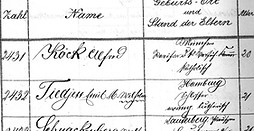
On April 8, 1902, Tiedjen entered the Academy of Fine Arts in Munich. The academy register lists him as “Emil M. Wilhelm Tiedjen,” age 21, born in Hamburg, and enrolled in the animal painting class of Heinrich von Zügel. This placed him directly within one of the important animal-painting circles of the Munich School. Zügel was a major animal painter and professor. Tiedjen did not just study under Zügel technically; he adopted Zügel’s artistic worldview.
1906
Age 25
Founded a private painting school
By 1906, Tiedjen had established his own school for landscape and animal painting in Wildenroth near Grafrath, Bavaria.
The school admitted both women and men, a significant detail at a time when many formal art academies still restricted women’s access.

1906
Age 25
Married Franziska Emilie "Fanny" Bieber
On 19 June 1909, Willy Tiedjen married Franziska Emilie Bieber in Munich.
Fanny, later known as Fanny Tiedjen-Bieber, was also an artist.
The couple appeared in contemporary exhibition contexts in 1909, suggesting that their artistic lives overlapped publicly as well as personally.

1914
Age 33
World War I and wartime exhibitions
During the First World War, in 1914, Willy donated an oil painting titled Deutsches Kriegsschiff for a Red Cross benefit.
In 1916 and 1918, his maritime works were displayed in officers’ facilities at the German Army’s Great General Headquarters alongside works by other marine painters.
Bavarian military personnel rosters also record his service in the 2nd Bavarian Infantry Regiment, 1st Replacement Battalion.
%20EMIL%20MARTIN%20WILHELM%20TIEDJEN.jpg)
1914
Age 33
International circulation of Willy's work
By the 1920s, Tiedjen’s paintings were circulating beyond Germany. In 1927, several works were purchased directly from the artist by California hotelier and collector William A. Matern. After Matern’s death, many of these paintings were donated to the Orthopedic Hospital in Los Angeles

1915
Age 34
Feldpost postcard circulation
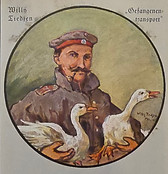
Several of Tiedjen’s animal and genre scenes circulated as German Feldpost postcards during the war. One example, Gefangenentransport (“Prisoner Transport”), shows a German soldier carrying two geese, a humorous wartime image that also reflects Tiedjen’s reputation as an “Entenmaler,” or duck painter.
1926
Age 45
Willy and Fanny listed together in the art market handbook
The 1926 Handbuch des Kunstmarkts lists Willy Tiedjen and Fanny Tiedjen-Bieber at Kurfürstenstraße 8 in Munich.
Willy is described as a painter and graphic artist specializing in animal and landscape subjects, while Fanny is listed as a painter and member of the Royal Association of Munich Women Artists. She is listed in other advertisements as displaying her embroidery and needle work.

1935
Age 54
Regime-aligned press profile
An article highlighting Tiedjen described him in highly political, regime-aligned terms, including as an “old follower of the Führer.”
The article also claimed he had served with the Freikorps von Epp during the conflict in Munich and had given Hitler a painting titled Münchener Entenhochzeitsfest.

1936
Age 55
Solo Exhibition in Munich
Around the time of his 50th birthday, Tiedjen held a solo exhibition at Galerie Jordan in Munich. A contemporary review highlighted his southern German landscapes, harbor scenes, use of color, light, and atmosphere.
Galerie Jordan (officially known as Kunsthandlung - Gebrüder Jordan & Co.) was a prominent, Jewish-owned art gallery in Munich.
Because the gallery was Jewish-owned, the Jordans were subjected to severe antisemitic persecution and targeted to the point of being forced to give up their business.
One day after Kristallnacht on November 9, 1938, Siegfried Jordan was deported to Dachau concentration camp and imprisoned there until December 6, 1938.
In May 1939, Siegfried and Paula Jordan managed to arrange for their then 15-year-old son, Peter, to emigrate to Great Britain. They hoped to be able to follow him soon.
In the spring of 1940, Siegfried and Paula Jordan had to leave their apartment on Mauerkircherstrasse. They lived for a time in a boarding house at Leopoldstrasse 16. Together with around 1,000 other Jewish women, men, and children, Siegfried and Paula Jordan received the first deportation order in Munich.
On November 20, 1941, the Gestapo took them to the "Jewish settlement Milbertshofen" at Knorrstrasse 148 and deported them to Kaunas, Lithuania. There, SS Einsatzgruppen shot them on November 25, 1941, and buried them in mass graves.


View Record >
~ 1943?
Loss of the his art studio
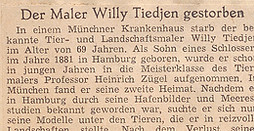
During the Second World War, Tiedjen lost his Schwabing studio in Munich to bombing. A later obituary reported that this forced him to move part of his practice to Garmisch-Partenkirchen. This loss became one of the defining late-life disruptions in the Tiedjens’ artistic story.
1945-1946
Age 45
Works recorded at the Munich Central Collecting Point
After the war, several works by Willy Tiedjen entered the Munich Central Collecting Point, the Allied facility used to process artworks that had been looted, confiscated, displaced, or otherwise caught in the upheaval of the Nazi period and war. These records connect Tiedjen’s work to the larger postwar provenance landscape, including works associated with Haus der Deutschen Kunst exhibitions, Reich Chancellery acquisitions, and files labeled “Führerankäufe” — “Führer purchases.”

1950
Age 69
Death in Munich
Willy Tiedjen died in Munich on 16 January 1950 at the age of 68. He was buried in the Waldfriedhof, Munich’s Forest Cemetery, in the area reserved for artists’ graves.